
Feeding your rabbits is one of the most important pillars of successful rabbit production. Feeding is a feature of domesticated rabbits under your care. Whether you are raising them as pets or commercially for meat, providing safe and nutritious food every day is essential. Rabbits have sensitive digestive systems, and feeding them unsafe or poor-quality food can lead to stunted growth, gut upsets, gastrointestinal stasis, and even death as discussed in our article on rabbit feeding mistakes.
Rabbits interact with a variety of feeds daily — from fiber-rich hay, commercial pellets, to fresh greens, and occasional fermented or sugarly treats like carrots. While these foods supply essential nutrients, they also create environments where different types of fungi can appear. Some fungi are beneficial, such as probiotic yeasts that support a rabbit’s gut microbiome; some are harmless, like environmental spores that pose no risk; and some are harmful, including moulds that produce mycotoxins in improperly stored feed. Understanding how fungi relate to a rabbit’s diet and environment is key to maintaining a healthy digestive system while also revealing fascinating examples from nature.
1. Harmful Fungi: Mycotoxin Producers

Right: Heaped Lucerne hay moulding under trapped moisture on a tarpaulin.
Photos by Rabbit Crew Kenya
A common source of harmful fungi is mouldy feed or poorly dried or stored hay, and even pellets made from contaminated grains can pose a risk. Certain Aspergillus species, such as A. flavus and A. fumigatus, produce mycotoxins, including aflatoxins, which may cause digestive upset, reduced appetite, liver damage, weakened immunity, poor growth, reproductive issues, and, in severe cases, sudden death.
Professional rabbit pellet formulators produce pellets that include toxin binders, which help prevent absorption of these toxins in the gut. However, their protective effect is limited to toxins already present in the feed at the time of production. If pellets are stored improperly after purchase, for example in a damp store, over 6 months in the agrovet shop, or over polythene or cement where moisture allows mould growth (as in the images above), new mycotoxins can develop. In such cases, toxin binders cannot prevent the effects of newly formed moulds at such a larger new scale, making proper feed handling and storage essential. The manufacturer does not factor a scenario where new toxins grow under careless storage post-purchase.
How to protect your rabbits:
- Store hay and pellets in dry, well-ventilated areas, not in rain, preferrably over wooden pallets.
- Avoid piling hay or greens tightly over polythene or cement during drying after fresh harvesting.
- Discard any mouldy feed immediately.
- If you are an agrovet, avoid stocking pellets that remain unsold for more than six months, as part of ethical trade practices.
2. Harmless Fungi: Nature’s Oddities
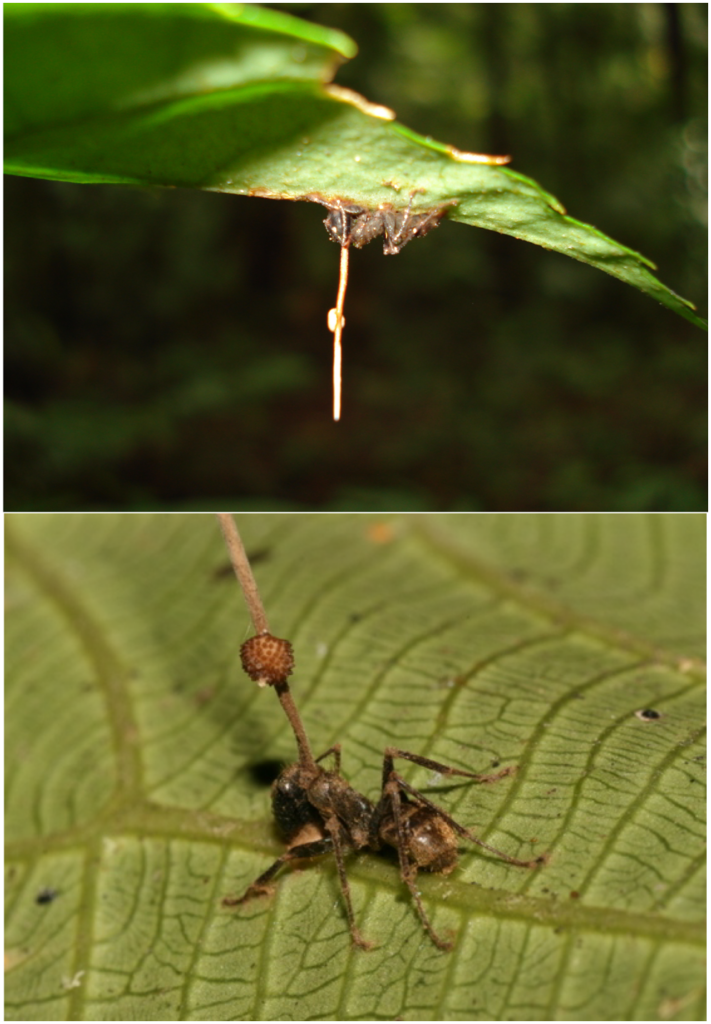
Some fungi are fascinating but pose no risk to rabbits or humans. A famous example is Cordyceps, the “zombie ant” fungus.
How it works:
- Cordyceps spores infect an ant and grow inside its muscles
- The fungus releases chemicals that alter the ant’s behavior, forcing it to climb a plant and bite a leaf vein
- The ant dies in this “death grip,” and the fungus eventually grows stalks that release more spores
Important facts:
- Humans and rabbits are completely safe — Cordyceps can only infect certain insects.
- This is a great example of nature’s complexity, not a threat to your rabbits.
3. Beneficial Fungi: Probiotics for a Healthy Gut
Rabbits rely on a fermenting gut system, particularly the caecum, to digest fiber and extract nutrients. Certain fungi, such as yeasts in probiotic supplementary treats, support gut health by:
- Improving digestion
- Maintaining a balanced gut microbiome
- Supporting immunity
- Enhancing nutrient absorption
Tips for giving probiotics to rabbits:
- Use sparingly as a treat (e.g., a teaspoon of water or milk kefir sprinkled over pellets, or another rabbit suitable probiotic supplement)
- This is only a supplementary treat—do not feed in bulk. It supports an already well-fed rabbit.
- A rabbit’s primary diet should always be hay or fibre-rich foods, making up at least 85% of daily intake. Pellets provide nutrient-dense support at around 10% of the diet by volume. If feeding greens consistently, give them as part of the main diet, preferably dried rather than fresh when including them with hay.
- Finally, treats such as probiotics help support digestion, while occasional luxury treats like clean carrots can be given sparingly.
- Pellets, though only around 10% of a rabbit’s diet by volume, are the most nutrient-dense component. They are especially important when the hay portion is low in variety or nutrient content.
- Eliminating pellets in such cases can have negative consequences, as rabbits fed only poor-quality hay may suffer health issues or even die suddenly, as discussed in our Top Reasons for Sudden Rabbit Deaths article.
Keep your rabbits healthy and thriving! Learn more about proper feeding, housing, breeding, and breed selection, and discover how to manage all aspects of rabbit production for a happy, productive flock by enrolling in our monthly Rabbit Production Trainings. You can also support your rabbits’ digestion safely with our rabbit-friendly probiotic supplements.
Good knowledge
Glad you loved it sir!
A very educative,I learnt a lot,thanks ad be blessed for teaching us.
Much welcome Joska Rabbits Farm! Wishing you success in your farming.